A Response to the Critics of “Christian Privilege” in America
Find the right tree on a hot August afternoon and you will understand something about civilization that no lecture can teach. The shade beneath a great oak is not an accident. It is the accumulated result of decades — sometimes centuries — of growth, of roots driving deep into the earth, of branches spreading wide because the seed and soil and years all conspired together in exactly the right way. You did not plant this tree. You arrived beneath it already grown. You are cool where others are not. You are sheltered where others burn.
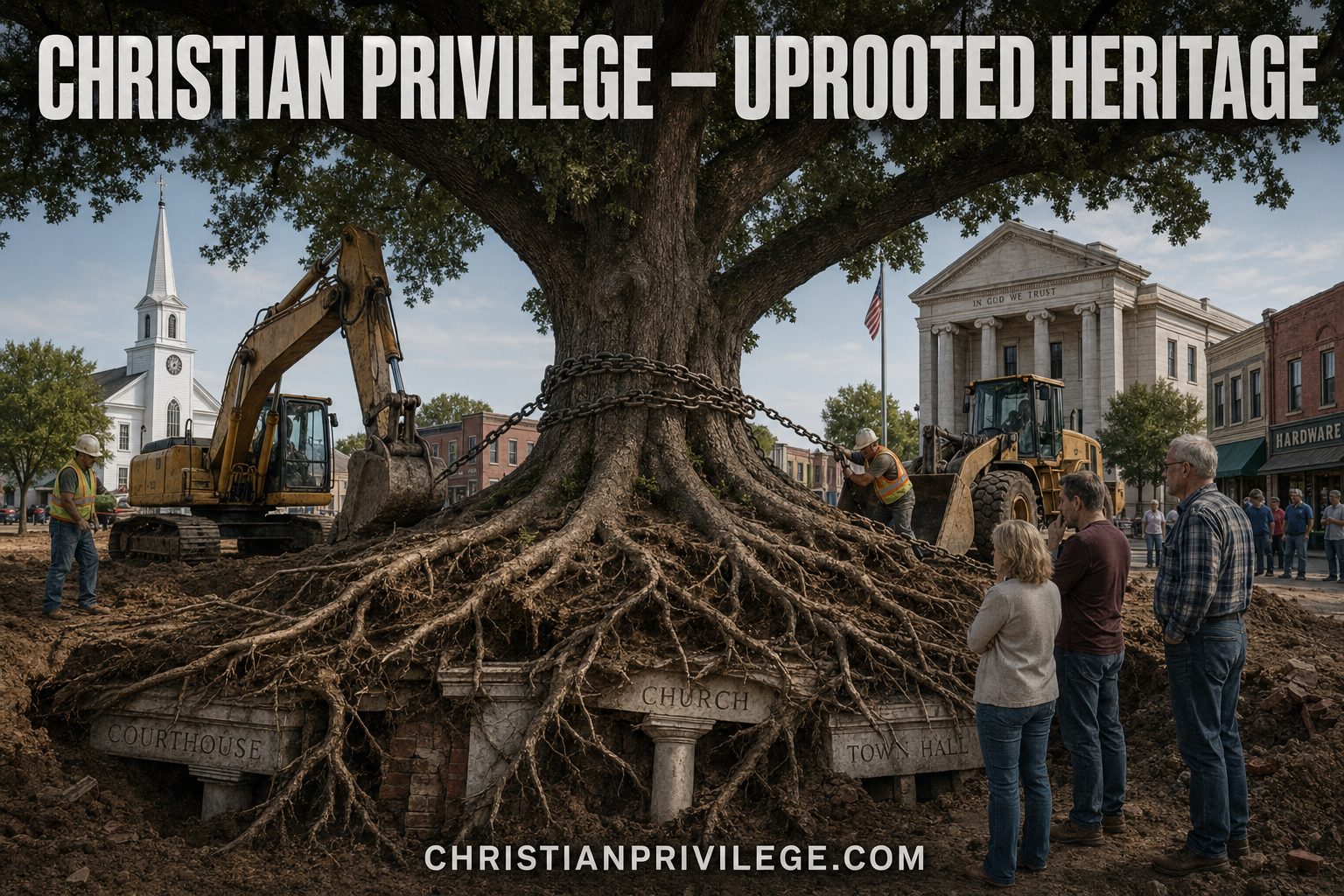
Now imagine someone standing at the edge of that shade, enjoying every benefit of it — the coolness, the breeze through the canopy, the sturdy branch above them that could hold a swing or bear a storm — and instead of gratitude, offering a list of complaints. The leaves are the wrong shape. The bark is too rough. The tree doesn’t look like the trees from back home. The name they have given this complaint is privilege.
This article is a response to that complaint — offered respectfully, with an eye toward both the person standing in the shade and the long, extraordinary story of how this particular oak came to grow here.
Christian Privilege and the Seed That Became a Nation
Every oak tree begins as an acorn. Inside that acorn is not a mystery — it is a blueprint. The DNA of the oak is present from the first moment, encoded in every cell, determining the shape of every leaf that will ever unfurl on every branch this tree will ever produce. You cannot plant an acorn and grow a maple. You cannot plant a Christian civilization and harvest a secular one. The seed determines the tree.
America’s seed was explicitly, deliberately, and repeatedly identified by the people who planted it. They were not vague about what they were growing. They wrote it down.
John Adams, the nation’s second President, stated without equivocation: “Our Constitution was made only for a moral and religious people. It is wholly inadequate to the government of any other.” He was equally plain about what “religious” meant in this context: “The general principles on which the fathers achieved independence were the general principles of Christianity. I will avow that I then believed, and now believe, that those general principles of Christianity are as eternal and immutable as the existence and attributes of God.”
George Washington described the moral root system without which the entire tree would topple. In his Farewell Address — his parting gift of wisdom to the nation — he wrote: “Of all the dispositions and habits which lead to political prosperity, religion and morality are indispensable supports. In vain would that man claim the tribute of patriotism, who should labor to subvert these great pillars of human happiness, these firmest props of the duties of men and citizens.” He added a warning, quiet as the rustling of leaves, that now echoes like thunder: “Let us with caution indulge the supposition that morality can be maintained without religion… reason and experience both forbid us to expect that national morality can prevail in exclusion of religious principle.”
Benjamin Franklin, when the Constitutional Convention of 1787 was on the verge of fracturing — when the entire sapling of the republic might have died before it grew — rose and delivered one of the most consequential speeches in American history: “I have lived, Sir, a long time, and the longer I live, the more convincing proofs I see of this truth — that God governs in the affairs of men. And if a sparrow cannot fall to the ground without His notice, is it probable that an empire can rise without His aid? We have been assured, Sir, in the sacred writings, that ‘except the Lord build the House, they labor in vain that build it.'”
Thomas Jefferson, who carved into the Declaration of Independence the theological premise on which all American rights rest, wrote: “God who gave us life gave us liberty. Can the liberties of a nation be secure when we have removed a conviction that these liberties are the gift of God? Indeed I tremble for my country when I reflect that God is just, that his justice cannot sleep forever.”
Noah Webster, who gave America its language and its first system of public education, understood what the cultivators were growing: “The religion which has introduced civil liberty is the religion of Christ and His apostles… to this we owe our free constitutions of government.” And Patrick Henry, whose voice lit the Revolution like a match to dry timber, kept his priorities clearly ordered: “Being a Christian… is a character which I prize far above all this world has or can boast.”
This was the seed. This was the plan. There was never a moment — not at Jamestown, not at Plymouth, not at Philadelphia in 1787, not at any point in the republic’s long growth — when this oak was anything other than an oak.
Christian Privilege and the Shape of the Leaves
Now come the complaints about the leaves.
The leaves are shaped like Christian leaves, the critics say. The national holidays follow a Christian calendar. The moral assumptions embedded in law and custom reflect a Christian worldview. The rhetoric of rights draws on Christian theology. Even the concept of a conscience that no government can rightfully coerce — the very idea that protects the critics who are criticizing — comes from a Christian understanding of the human soul.
The critics have compiled careful lists of all the ways in which the leaves of this tree are oak-shaped rather than maple-shaped or palm-shaped or willow-shaped. One widely cited checklist, assembled by academic Lewis Z. Schlosser, notes that Christians can expect “state and federal holidays to coincide with their religious practices” — as though the fact that an oak tree produces acorns rather than coconuts is evidence of injustice toward those who prefer coconuts.
But consider what the complaint actually amounts to. The tree grew from a Christian seed, in Christian soil, tended by Christian cultivators, according to a Christian design that was explicitly proclaimed at every stage of its development. The leaves are oak-shaped because this is an oak tree. That is not a policy choice that can be revised. It is a biological fact about what was planted.
The alternative — a tree with leaves from every species on earth — is not a tree. It is a philosophical abstraction with no roots deep enough to hold against a real storm.
Christian Privilege and the Other Trees in the Grove
Here is the part of the complaint that is almost never acknowledged: there are other trees.
The grove of human civilization is wide. Other seeds were planted in other soils — Islamic civilization, Hindu civilization, Buddhist civilization, Confucian civilization — and each grew according to its own DNA, producing its own shade, its own fruit, its own character. These are real trees. They have their own histories, their own wisdom, their own communities of people who love them deeply.
America’s oak, rooted as it is in Christian principles, has never forbidden anyone from planting or tending their own tree. The First Amendment — itself a product of the Christian conviction that conscience belongs to God alone — guarantees every person in America the freedom to worship, to organize, to build institutions, to raise children, to live according to the laws of whatever tradition they hold sacred. The grove is open. The soil is free. There is room.
John Jay, the first Chief Justice of the United States Supreme Court, expressed what the oak’s cultivators believed: “Providence has given to our people the choice of their rulers, and it is the duty, as well as the privilege and interest of our Christian nation, to select and prefer Christians for their rulers.” This was not a declaration of hostility toward other traditions. It was an honest accounting of what kind of tree had been planted, and what kind of fruit it was designed to bear.
No one who sits under a different tree in the grove is prevented from doing so. No law compels the Buddhist or the Hindu or the atheist to worship at a Christian altar. The shade of the oak is simply available to all who choose to stand beneath it — and those who find it insufficiently familiar are entirely free to find shade elsewhere in the grove, or to grow their own.
Christian Privilege and the Features That Make the Shade Worth Seeking
Now we arrive at the most revealing part of the conversation.
The person complaining about the shape of the oak leaves has already admitted, perhaps without realizing it, that they prefer standing under this tree. They like the shade. The branches are strong enough to bear weight. The roots hold firm in a storm when the saplings around it bend and snap. The canopy is wider, the coverage more reliable, the shelter more complete.
These are not accidents of climate or geography. They are expressions of the tree’s DNA.
The ordered liberty of American society, the protection of individual rights, the rule of law that applies equally to the powerful and the powerless, the tradition of voluntary charity that built hospitals and universities and orphanages without government compulsion — these are leaves of the same tree as the Christmas holiday on the federal calendar. They come from the same root system. You cannot have one without the other.
John Adams knew this: “We have no government armed with power capable of contending with human passions unbridled by morality and religion.” The shade of ordered liberty is possible only because the roots run deep into moral soil. Sever the roots in the name of neutrality, and the canopy collapses.
Jedidiah Morse, the founding era’s great geographer and pastor, traced the causal chain with precision: “To the kindly influence of Christianity we owe that degree of civil freedom, and political and social happiness which mankind now enjoy. In proportion as the genuine effects of Christianity are diminished in any nation, either through unbelief, or the corruption of its doctrines, or the neglect of its institutions — in the same proportion will the people of that nation recede from the blessings of genuine freedom, and approximate the miseries of complete despotism.”
The shade and the leaf shape are one and the same thing. You cannot enjoy the former while legislating away the latter.
Christian Privilege and the Tree That Must Remain Itself
If what you love about the oak is its shade, its strength, its enduring rootedness — and what you dislike is merely that its leaves are not shaped like the leaves from your country — then the productive response is not to demand that the oak stop being an oak.
The productive response is to go to your own tree and cultivate it toward the same virtues.
This is not dismissal. It is genuine encouragement. If another religious or cultural tradition can produce the same depth of shade — the same ordered liberty, the same protection of the individual conscience, the same charitable spirit, the same commitment to equal justice — then let it prove that in the open air of the grove. Let it grow. Let it compete on the merits of what it produces.
But standing at the base of the oak, demanding that it shed its leaves and adopt the foliage of a completely different species, is not a plea for justice. It is a demand that the tree destroy itself in order to make the critic comfortable. And the most damning irony of all is this: if the oak complied — if it stripped itself of its own character in order to be something palatable to every taste — the shade would disappear. The canopy would thin. The great branches would weaken. And the very people who demanded the transformation would quietly wander off in search of a tree that still has its leaves.
Daniel Webster, who spent a lifetime defending what the founders built, said it plainly: “Whatever makes men good Christians, makes them good citizens.” The character of the tree and the quality of its shade are not two separate things. They are one thing, expressed in two ways.
Noah Webster drew the logical conclusion that follows from this: “I am persuaded that no civil government of a republican form can exist and be durable in which the principles of Christianity have not a controlling influence.” An oak that abandons its own nature does not become a superior tree. It becomes a dying one.
Christian Privilege and the Reason People Come to This Tree
People have been traveling from every corner of the earth to stand under this particular oak for four centuries. They came from countries where the shade was thin or nonexistent — where the government claimed the right to your conscience, where the law was whatever the strongest man declared it to be, where the individual was owned by the collective and had no standing to object.
They came here because this tree was different. Because something in the character of this civilization — its understanding of human dignity, its protection of the individual against the power of the state, its willingness to let a person build something and keep it — made it worth crossing oceans for.
Joseph Story, Associate Justice of the Supreme Court appointed by James Madison and the father of American jurisprudence, identified the root: “I verily believe Christianity necessary to the support of civil society. One of the beautiful boasts of our municipal jurisprudence is that Christianity is a part of the Common Law. There never has been a period in which the Common Law did not recognize Christianity as lying at its foundations.”
They came for the oak. They came because no other tree in the grove was producing shade like this one. And they were right to come — the oak welcomes all who seek its shelter. It has always welcomed them. The First Amendment is not a footnote to the founding; it is one of the great leaves of the tree, grown from the same Christian conviction that the human conscience is sacred and that no state may own it.
But the oak did not become what it is by trying to be everything. It became what it is by being fully, deeply, uncompromisingly itself.
Conclusion: Christian Privilege and the Deepest Roots
The argument for so-called “Christian privilege” assumes that the visibility of Christianity in American public life is a form of oppression — that the shape of the oak’s leaves is an act of violence against those who prefer different leaves. It mistakes the identity of a civilization for a policy of exclusion.
The oak is an oak because an acorn was planted. The acorn was planted by people who knew exactly what they were growing, who said so publicly and repeatedly, and who built into the very structure of the tree a canopy wide enough to shelter everyone who came — regardless of where they came from or what their own trees looked like back home.
The shade is real. The roots are deep. The branches have held through wars and depressions and moral crises that would have felled a lesser tree. None of that happened by accident, and none of it can be preserved by pretending that the tree has no particular nature.
The man with the complaint about the leaf shape is welcome here. The shade is genuinely offered. Let him sit beneath it, be grateful for it, and understand — perhaps for the first time — that the thing he finds so comfortable and so worth preserving is not separable from the thing he wishes would change.
The roots go down before the branches go up. That is not privilege. That is botany.
All founder quotations are drawn from primary source documents and authenticated historical records.